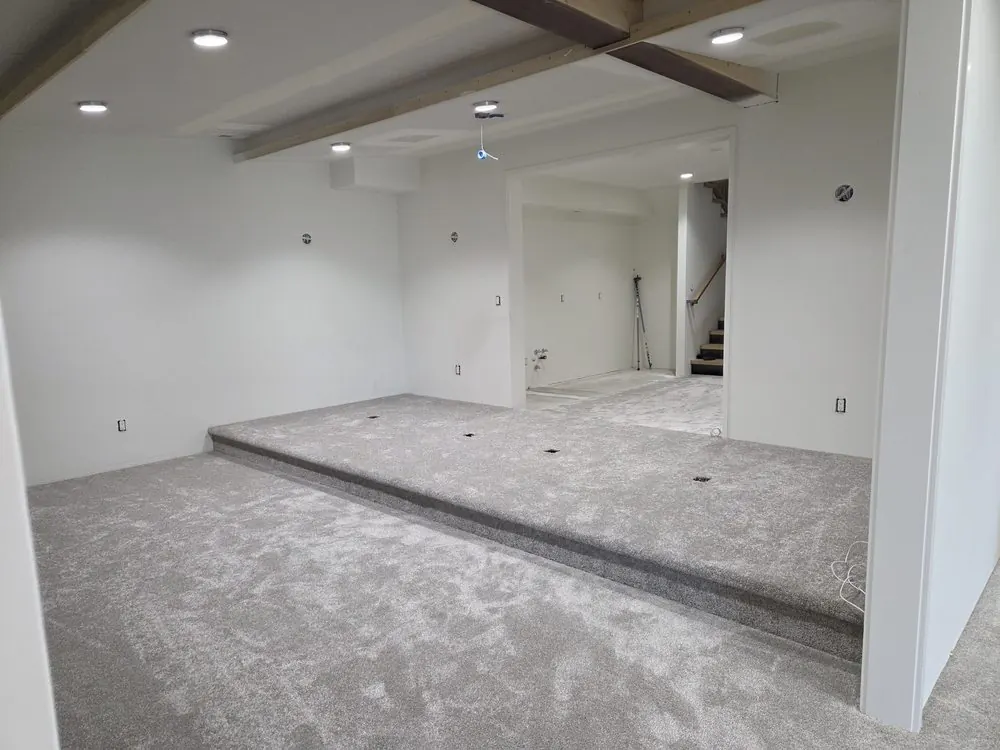
A basement is the cheapest square footage you will ever add to your house. The foundation, walls, and roof are already there — you're paying to make the space livable, not to build it. For Seattle and Eastside homeowners who need another bedroom, a home office, a gym, or a theater room, finishing the basement is usually a better deal than an addition.
Here's what it actually costs, what drives the price up, and what to check before you commit.
Cost depends almost entirely on scope. Finishing one room — framing, insulation, drywall, flooring and lighting — can start around $10,000. A full 800–1,000 square foot basement with a bedroom and bathroom runs well into six figures. Here's how it typically breaks down:
| Scope | Estimated Cost | What's Included |
|---|---|---|
| Basic Finish | $10,000 – $60,000 | Framing, insulation, drywall, flooring, lighting, electrical, paint, heating — the low end covers a smaller room or a partially finished space |
| With Bedroom & Bathroom | $65,000 – $110,000 | Above, plus egress window, full bath rough-in and finish, closet, upgraded panel |
| Full Suite / ADU-Level | $110,000 – $180,000+ | Above, plus kitchenette, separate entrance, sound isolation, permitting as a separate unit |
These are realistic ranges for the Seattle and Eastside market, not national averages. Every basement is different, so treat them as a starting point rather than a quote.
Before you plan anything else, check two numbers: your ceiling height and whether your basement has ever taken on water. Those two answers determine more about your budget than any finish you pick.
We get a lot of rain, and Seattle basements are often cut into sloped lots where groundwater pushes against the foundation. Before any framing goes up, the space needs to be dry and stay dry — that means checking the perimeter drainage, grading around the house, downspout discharge, and any history of seepage. We also install a vapor barrier and use moisture-tolerant materials at the base of walls as standard practice. Drywall and framing installed against a damp foundation wall will grow mold, and you won't see it until it's a real problem.
Yes. Finishing a basement changes it from unconditioned storage to habitable space, which requires a building permit in Seattle and across the Eastside. Permits cover framing, egress, electrical, plumbing, and insulation. Unpermitted finished basements routinely get flagged during a home sale, and the square footage usually won't count toward your home's official size on the appraisal — which means you paid for the work and don't get credit for it. Our Seattle permit guide walks through the process.
A straightforward basic finish usually runs 4–6 weeks of construction. Add a bathroom and an egress window and you're looking at 7–10 weeks. Permit review happens before any of that and varies by jurisdiction — budget several weeks, sometimes longer in the City of Seattle than in the suburban Eastside cities.
Finished basements generally return a solid share of their cost at resale, and they're one of the better-value projects precisely because the shell already exists. Two conditions matter: the work must be permitted, and the ceiling height must meet code — otherwise an appraiser may not count the space as finished square footage at all. A permitted, code-height basement with a legal bedroom and a full bath is worth substantially more than a nicely finished room that doesn't meet either standard.
If you're weighing a basement against other ways to add space, our garage conversion guide and ADU guide cover the alternatives and what each one costs.
We'll walk your basement, check height and moisture, and give you a transparent itemized quote — no pressure, no obligation.
Schedule My Free Estimate →