Why Mini Splits Beat Central AC in Most Seattle Homes
As Seattle summers get hotter, more Eastside homeowners are finally investing in climate control. Central AC sounds like the obvious answer — but for most homes in our area, it's actually the less effective and more expensive choice. Here's why mini split heat pumps win in almost every scenario we see.
Why homeowners choose mini splits:
- ✅ Heats AND cools — one system replaces your AC and supplements your furnace
- ✅ Works floor by floor — solves the hot-upstairs problem central AC can't fix
- ✅ Up to 3× more efficient — no energy lost through leaky ductwork
- ✅ No ductwork needed — installed in 1–2 days with minimal disruption
- ✅ Utility rebates available — PSE and Seattle City Light offer up to $1,500 back
The Physics Problem with Central AC in Multi-Story Homes
This is the part most HVAC salespeople won't tell you upfront: cold air sinks and hot air rises. That's basic physics — and it's a serious problem for central AC in two-story homes or split-level layouts.
When central AC pumps cold air through ceiling vents, it immediately drops to floor level. The upstairs bedrooms stay warm while the downstairs gets overcooled. The thermostat reads an average — so the system keeps running trying to hit a target that doesn't reflect what's actually happening in each room. You end up with one floor too cold, one floor too warm, and an energy bill that reflects both.
Sound familiar?
If you've ever cranked the AC only to find your upstairs bedrooms still stuffy while the main floor feels like a refrigerator — that's the physics problem in action. Central AC treats your whole home as one zone, which simply doesn't work in a multi-level layout.
Mini splits solve this completely. Each unit is mounted on the wall of the room it serves, delivering conditioned air exactly where it's needed. The bedroom upstairs gets its own unit. The living area gets its own unit. Each one operates independently — you only run what you need, at the temperature that room actually requires.
Mini Splits Do Both — Heat and Cool
This is the part that surprises most homeowners: a mini split isn't just an AC — it's a full heat pump. The same unit that cools your living room in August will heat it in January, and it does so at a fraction of the cost of running electric baseboard heat or a gas furnace.
Modern mini splits operate efficiently in outdoor temperatures as low as 5°F — well below anything Seattle typically sees. They move heat rather than generate it, which makes them 2–4× more efficient than traditional electric heating. For homeowners heating with oil or aging baseboard systems, switching to mini splits often cuts heating costs significantly.

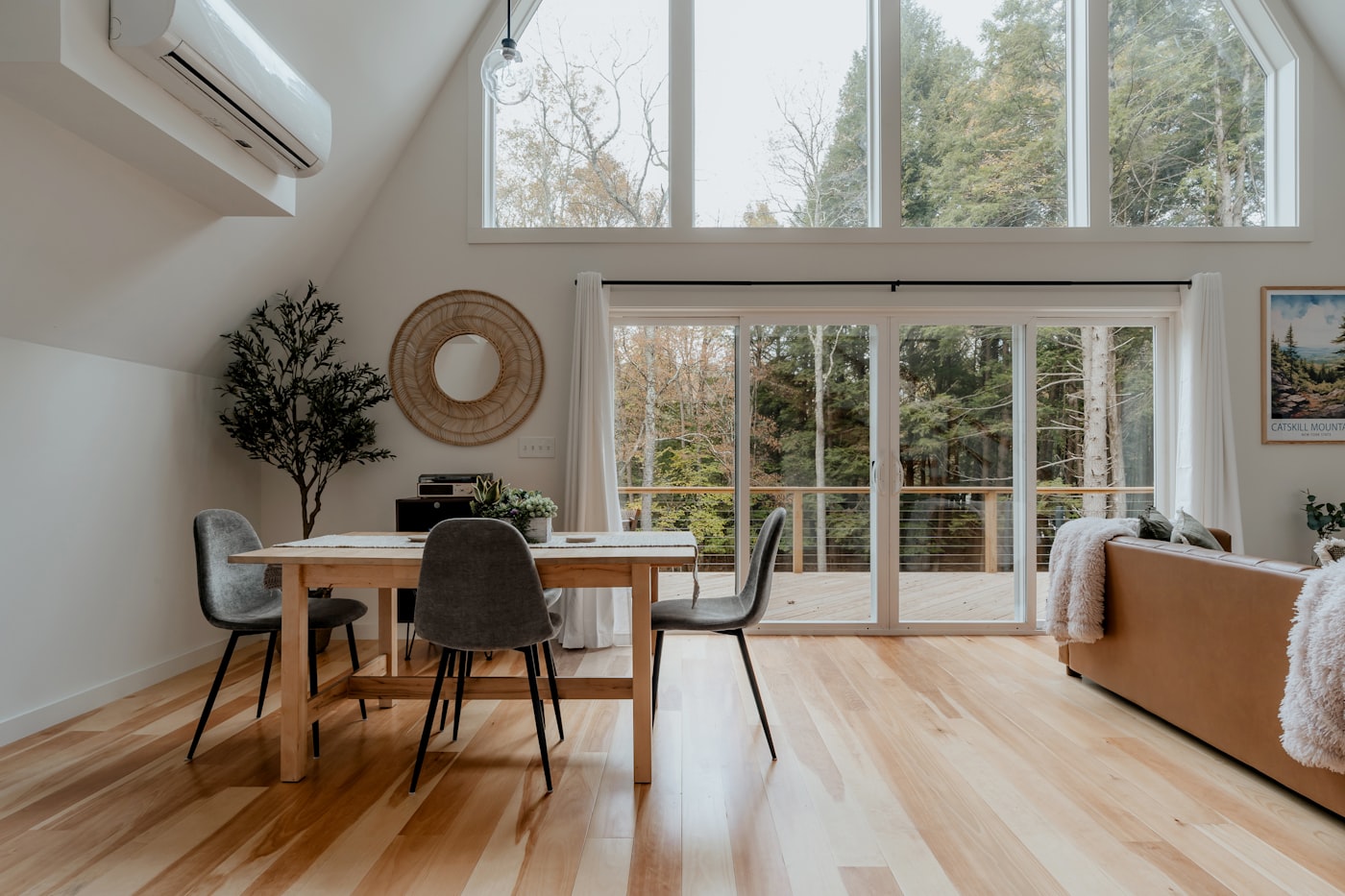
A modern mini split blends cleanly into a well-designed living space.
Energy Efficiency: Where Mini Splits Really Shine
Central AC systems lose a significant amount of energy through ductwork — leaks, poor insulation, and long runs all bleed efficiency before the cool air even reaches the room. Studies estimate duct losses of 20–30% in a typical home.
Mini splits have no ducts. Every unit of energy the system uses goes directly toward conditioning the space. Combined with inverter-driven compressors that modulate speed rather than cycling on and off, mini splits consistently outperform central systems on efficiency — especially over a full year of heating and cooling.
- No duct losses — 100% of output reaches the room
- Inverter technology — runs at exactly the speed needed, no wasted on/off cycling
- Zone control — only condition occupied rooms, not empty ones
- Heat pump efficiency — delivers 2–4× more energy than it consumes
💡 PSE and Seattle City Light currently offer rebates of up to $1,500 per heat pump unit for qualifying installations. Ask us about rebate eligibility when you book your estimate.
How Mini Splits Compare to Central AC
| Factor | Mini Split | Central AC |
|---|---|---|
| Works in multi-story homes | Yes — per-room control | Poor — hot air rises, cold drops |
| Energy efficiency | Very high (no duct losses) | Moderate (20–30% duct loss typical) |
| Provides heat too | Yes — down to 5°F outside | No (separate furnace needed) |
| Requires ductwork | No | Yes — expensive to add |
| Zone control | Per room | Whole-home only (or costly add-on) |
| Install time | 1–2 days per unit | 3–5+ days |
| Noise indoors | Very quiet | Moderate fan noise |
| Best for | Most Seattle homes | Homes with existing good ductwork |
What Does Installation Cost?
For a typical 2–3 bedroom Eastside home:
- Single-zone mini split (one room or open plan): $3,000 – $5,500 installed
- 2-zone system (living area + primary bedroom): $6,000 – $11,000 installed
- 3-zone system (whole-home coverage): $10,000 – $18,000 installed
Compare that to adding central AC with new ductwork — which typically runs $14,000 – $25,000+, takes more time to install, and still won't solve the hot-upstairs problem.
Our Honest Recommendation
For two-story homes, split-levels, or any home without existing ductwork — a mini split heat pump is almost always the smarter investment. You get precise room-by-room comfort in summer and winter, better efficiency, and a faster, less disruptive installation. The only scenario where central AC makes more sense is if you already have good ductwork in place and only need cooling — in that case, adding a central cooling coil can be cost-effective.
Find Out What's Right for Your Home
We install mini split heat pumps throughout Seattle and the Eastside. We'll assess your home's layout and give you an honest recommendation — no upselling, no pressure.
Schedule My Free Estimate →